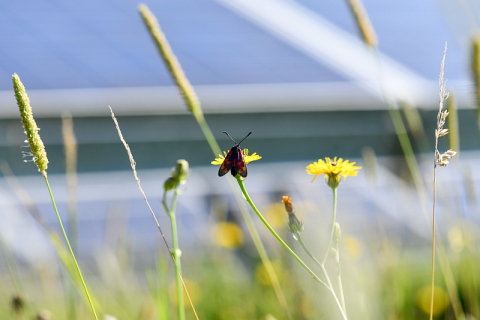
The Insect Ecology Team at the Czech University of Life Sciences Prague, supported by the Technology Agency of the Czech Republic and the European Union (under the NextGenerationEU programme), in collaboration with Photon Energy, is carrying out a unique project focused on optimizing biodiversity support in solar power plant sites.
We would like to invite you to a practical workshop and field excursion taking place on Friday, May 15, 2026, directly at the Komorovice solar power plant near Humpolec.
The workshop is intended for solar plant owners and operators, developers, and public sector representatives interested in modern, environmentally responsible approaches to solar energy.
Participants will have the opportunity to discuss both the benefits and challenges of implementing these measures, including their potential to reduce long-term vegetation maintenance costs.
Date: Friday, May 15, 2026
8:30 AM in Prague (shared bus), or
10:00 AM on-site in Komorovice
Presentations of implemented measures, hands-on field demonstrations, lunch at a brewery in Humpolec, and networking.
Please note: the workshop will be conducted in Czech.
In 2024 and 2025, an extensive biological survey was conducted across seventeen solar power plants throughout the Czech Republic. The monitoring results revealed that solar parks can host surprisingly diverse ecosystems:
At the Komorovice site in particular, the presence of the endangered large copper butterfly (Lycaena dispar) has been confirmed, along with a number of other ecologically demanding species. This highlights the strong biodiversity potential of the open spaces between solar panels.
Komorovice serves as a pilot site where specific biodiversity-support measures were implemented over the past year. These will be presented during the workshop.
Key features include:
The project “Optimizing Biodiversity Support in Solar Parks Located in Open Landscapes” (No. SS07020239) is funded by the EU LIFE Programme – Environment for Life and supported by the Technology Agency of the Czech Republic.

The research project led by the Czech University of Life Sciences Prague examines how solar parks can act as biodiversity hotspots in otherwise monocultural landscapes. Researchers are studying vegetation and species at solar parks to develop standards for integrating biodiversity-enhancing measures.